
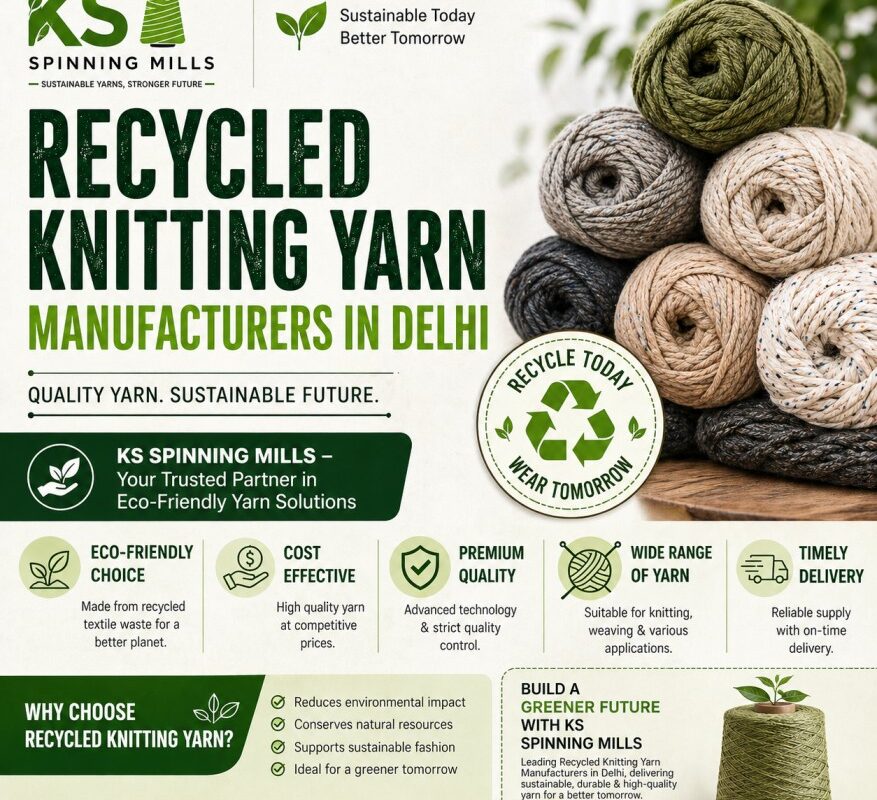
Recycled Knitting Yarn Manufacturers in Delhi – Why KS Spinning Mills is a Trusted Name

Recycled Knitting Yarn Manufacturers in Delhi – Why KS Spinning Mills is a Trusted Name

Recycled Knitting Yarn Manufacturers in Delhi – Why KS Spinning Mills is a Trusted Name

Introduction

In today’s fast-evolving textile industry, sustainability is no longer optional—it’s essential. Businesses and consumers alike are shifting towards eco-friendly alternatives, and one of the most impactful changes is the growing demand for recycled knitting yarn. If you are searching for reliable Recycled Knitting Yarn Manufacturers in Delhi, KS Spinning Mills stands out as a trusted and quality-driven name in the market.

This blog explores the importance of recycled yarn, its benefits, applications, and why KS Spinning Mills is a preferred choice for businesses across India.

What is Recycled Knitting Yarn?

Recycled knitting yarn is produced by reprocessing textile waste, fabric scraps, or used garments into new yarn. Instead of relying on fresh raw materials, manufacturers utilize sustainable processes to create high-quality yarn suitable for knitting, weaving, and textile production.

This eco-conscious approach helps:

  • Reduce textile waste
  • Save natural resources
  • Lower carbon emissions
  • Promote circular economy practices

Why Recycled Yarn is Gaining Popularity in Delhi

Delhi is one of India’s major textile hubs, with increasing awareness around sustainability and environmental responsibility. The demand for recycled knitting yarn is rising due to several reasons:

1. Environmental Benefits

Recycled yarn significantly reduces landfill waste and minimizes environmental pollution. It supports green manufacturing practices that are essential for the future.

2. Cost Efficiency

Compared to virgin yarn, recycled yarn is often more cost-effective, making it an ideal choice for bulk production.

3. Government Support

Policies encouraging sustainable manufacturing are driving textile businesses to adopt eco-friendly materials.

4. Consumer Awareness

Modern consumers prefer sustainable products, pushing brands to use recycled materials in their production.

Applications of Recycled Knitting Yarn

Recycled knitting yarn is versatile and widely used across multiple industries:

  • Garment Manufacturing (t-shirts, sweaters, activewear)
  • Home Textiles (carpets, rugs, upholstery)
  • Industrial Textiles
  • Fashion Accessories
  • Hand Knitting and Crafting

Its durability and adaptability make it suitable for both commercial and creative uses.

KS Spinning Mills – Leading Recycled Knitting Yarn Manufacturer in Delhi

When it comes to reliable recycled yarn production, KS Spinning Mills has established itself as a prominent manufacturer in Delhi. The company combines advanced technology with sustainable practices to deliver superior-quality yarn.

Key Strengths of KS Spinning Mills

1. High-Quality Standards

KS Spinning Mills ensures consistent quality by using modern machinery and strict quality control processes.

2. Sustainable Manufacturing

The company is committed to eco-friendly production, reducing waste and conserving resources.

3. Wide Product Range

They offer a diverse range of recycled knitting yarn suitable for various industrial and commercial applications.

4. Competitive Pricing

Affordable pricing makes them an ideal partner for bulk buyers and manufacturers.

5. Timely Delivery

With efficient logistics and production planning, KS Spinning Mills ensures on-time delivery for all orders.

Benefits of Choosing Recycled Knitting Yarn

Switching to recycled yarn offers multiple advantages for businesses:

✔ Eco-Friendly Production

Reduces environmental impact and supports sustainability goals.

✔ Cost Savings

Lower production costs without compromising quality.

✔ Brand Value Enhancement

Using sustainable materials improves brand reputation and attracts eco-conscious customers.

✔ Resource Conservation

Minimizes the need for raw materials like cotton and synthetic fibers.

How to Choose the Best Recycled Knitting Yarn Manufacturer in Delhi

Selecting the right manufacturer is crucial for quality and reliability. Here are key factors to consider:

1. Experience and Reputation

Choose a manufacturer with proven industry experience and positive client feedback.

2. Quality Assurance

Ensure the company follows strict quality control standards.

3. Customization Options

Look for manufacturers who can provide yarn as per your specifications.

4. Pricing and Transparency

Competitive pricing with clear terms is essential for long-term partnerships.

5. Sustainability Practices

Verify the company’s commitment to eco-friendly production.

KS Spinning Mills meets all these criteria, making it a dependable choice for businesses.Recycled Yarn vs Virgin Yarn – What’s Better?

FactorRecycled YarnVirgin Yarn
Environmental ImpactLowHigh
CostAffordableExpensive
Resource UsageMinimalHigh
SustainabilityExcellentLimited

Recycled yarn clearly offers a more sustainable and cost-effective solution for modern textile production.

Future of Recycled Knitting Yarn in India

The future of recycled knitting yarn in India looks promising. With increasing environmental concerns and stricter regulations, more businesses are expected to adopt sustainable materials.

Delhi, being a major textile hub, will continue to play a significant role in this transformation. Companies like KS Spinning Mills are leading this change by providing high-quality recycled yarn solutions.

Why KS Spinning Mills is the Right Choice

If you are looking for recycled knitting yarn manufacturers in Delhi, KS Spinning Mills offers the perfect blend of quality, affordability, and sustainability.

What sets them apart:

  • Advanced manufacturing technology
  • Eco-friendly production processes
  • Consistent product quality
  • Strong customer support
  • Bulk supply capabilities

Their commitment to excellence makes them a preferred partner for textile businesses across India.

Conclusion

The shift towards sustainable textiles is reshaping the industry, and recycled knitting yarn is at the forefront of this change. Choosing the right manufacturer is crucial to ensure quality, cost efficiency, and environmental responsibility.

KS Spinning Mills stands out as a leading recycled knitting yarn manufacturer in Delhi, offering reliable and eco-friendly solutions for modern textile needs.

If you want to reduce costs, improve sustainability, and enhance your brand value, switching to recycled knitting yarn is the right step forward.
How Recycled Weaving Yarn Is Transforming Sustainable Fabric Manufacturing

How Recycled Weaving Yarn Is Transforming Sustainable Fabric Manufacturing

How Recycled Weaving Yarn Is Transforming Sustainable Fabric Manufacturing

The textile industry is at a crossroads. Traditional manufacturing has long relied on virgin fibers and resource-intensive processes that contribute heavily to water use, energy consumption, and waste. Enter recycled weaving yarn — a practical, scalable solution that’s reshaping how fabrics are made, marketed, and valued. From diverting textile waste from landfills to lowering carbon footprints and unlocking new design possibilities, recycled weaving yarn is not just a green label: it’s a manufacturing revolution.

What is Recycled Weaving Yarn?

Recycled weaving yarn is yarn produced from reclaimed fibers rather than newly spun virgin fiber. Sources include post-consumer garments, industrial fabric offcuts, and pre-consumer textile waste. These materials are collected, sorted, cleaned, mechanically or chemically processed back into fibers, and then re-spun into yarns suitable for weaving. The end products can range from coarse utilitarian textiles to fine fabrics for apparel and home textiles, depending on the source material and processing technique.

Environmental benefits — immediate and measurable

One of the strongest arguments for recycled yarn is its environmental impact. Producing yarn from recycled fibers typically consumes far less water and energy than producing the same yarn from virgin synthetic or natural fibers. For example, mechanical recycling avoids water-heavy processes used in some virgin fiber manufacturing and reduces dependence on petrochemicals when recycling synthetic fibers like PET.

Recycling also tackles waste head-on. Millions of tons of textiles are landfilled or incinerated annually. By creating value from discarded clothing and fabric scraps, recycled yarn diverts waste streams, reduces landfill burden, and decreases greenhouse gas emissions associated with decomposition or incineration.

Beyond resource savings, recycled yarn encourages circular thinking — designing products and supply chains so materials remain in use for as long as possible. This shift from linear “take-make-dispose” models toward circular systems is essential for the long-term sustainability of textile manufacturing.

Quality and performance — myths busted

There’s a persistent myth that recycled yarns are inferior in quality. Modern recycling technologies and improved sorting systems have made it possible to produce recycled yarns with consistent, high performance. Mechanical recycling preserves a lot of the original fiber characteristics when carefully processed; chemical recycling (when applied responsibly) can regenerate fibers that closely resemble virgin material.

Blending recycled fibers with virgin fibers is a smart, common approach to achieve desired strength, hand, and drape. In woven fabrics, recycled yarns perform exceptionally well when engineered to the application — from durable upholstery textiles to breathable apparel fabrics. Manufacturers can also tune yarn counts, twists, and finishing processes to match legacy specifications.

Economic incentives for manufacturers

Using recycled weaving yarn can make strong business sense. For many mills, recycled yarns lower material costs — especially when recycled feedstock is sourced as a byproduct or through partnerships with waste management firms. Recycled yarns also open new markets: eco-conscious brands and consumers increasingly prefer products with recycled content, and many retailers now require sustainability credentials from suppliers.

Additionally, regulatory and corporate pressure for sustainability reporting and reduced Scope 3 emissions is incentivizing brands to source recycled materials. Producers who build capabilities in recycled yarns position themselves as strategic partners to buyers with sustainability targets, turning environmental stewardship into a competitive advantage.

Innovations driving adoption

Several technical and logistical innovations are accelerating recycled yarn adoption:

• Improved fiber sorting and automated pre-processing reduce contamination and raise the quality of recycled feedstock.
• Advances in chemical recycling enable PET and other synthetics to be broken down and rebuilt into high-quality polymers.
• Hybrid spinning and blending techniques allow recycled fibers to be combined with virgin fibers in controlled ratios for predictable performance.
• Traceability technologies — like blockchain and digital tagging — enable brands to verify recycled content and communicate authentic claims to consumers.

These developments lower barriers for large-scale manufacturing and give designers more confidence when specifying recycled yarns in woven constructions.

Design opportunities and consumer appeal

Recycled Weaving Yarn isn’t only about sustainability; it’s also inspiring new aesthetics. Recycled fibers often exhibit unique texture and tonal variations, which designers can use to create fabrics with character and storytelling potential. From heathered suiting cloths to textured home textiles, recycled yarns allow brands to differentiate through both ethics and design.

Consumers increasingly value transparency and authenticity. Fabrics made with recycled yarn carry a story — of resourcefulness and reduced environmental impact — that resonates with the modern buyer. Clear labeling and third-party certifications help translate that story into purchase decisions.

Challenges to scale — and how to address them

Despite the momentum, several challenges remain:

• Feedstock variability: Post-consumer textiles are a mixed bag. Better collection systems, take-back programs, and standardized sorting can help.
• Cost and investment: Upgrading mills for recycled processing requires capital. Collaborative financing models and public incentives can lower the barrier.
• Performance tradeoffs: Some high-performance applications still need virgin fibers; strategic blending and targeted applications can bridge gaps.
• Greenwashing risk: Transparent supply chains, certifications, and traceable documentation are essential to avoid misleading claims.

Addressing these obstacles requires coordinated effort across the value chain — from collection and recycling infrastructure to mill capabilities and brand commitments.

Practical steps for manufacturers and brands

To integrate recycled weaving yarn effectively, manufacturers and brands can follow practical steps:

  1. Audit material streams to identify potential recycled feedstock sources.
  2. Invest in or partner for sorting and pre-processing capability.
  3. Pilot blended yarns for different fabric applications to refine processes.
  4. Obtain recognized certifications (e.g., GRS, RCS) and implement traceability for credibility.
  5. Educate designers and customers on benefits and best uses of recycled yarns.

The future looks woven from reuse

Recycled weaving yarn is more than a niche; it’s a scalable lever for transforming textile production into a more sustainable, resilient industry. With supportive policies, continued technological progress, and honest communication, recycled yarn can reduce environmental harm while delivering attractive, high-performing fabrics for fashion, interiors, and industrial uses.

For mills and brands, the imperative is clear: embed recycling into product design and supply chains now. Doing so not only addresses immediate environmental challenges but also aligns businesses with the expectations of conscious consumers and the realities of a resource-constrained future. In short, recycled weaving yarn is helping the textile industry remake itself — one warp and weft at a time.

How KS Spinning Mills is Revolutionizing the Textile Industry with Recycled Yarn Fabrics

How KS Spinning Mills is Revolutionizing the Textile Industry with Recycled Yarn Fabrics

In a world increasingly focused on sustainability, the textile industry stands at a crucial crossroads. Fast fashion, once celebrated for its affordability and speed, has now become one of the major contributors to global pollution. Every year, millions of tons of textile waste end up in landfills, while the production of virgin cotton and polyester continues to strain natural resources. Amid this challenge, KS Spinning Mills has emerged as a beacon of change — leading the revolution with its innovative approach to Recycled Yarn Fabrics.

A Vision Rooted in Sustainability

At the heart of KS Spinning Mills’ philosophy lies a deep commitment to environmental responsibility and sustainable growth. The company believes that the future of textiles depends on how efficiently the industry can reuse, recycle, and reinvent materials.

By transforming textile waste into high-quality recycled yarn fabrics, KS Spinning Mills has taken a decisive step toward building a circular textile economy — where waste is no longer a byproduct but a resource. This approach not only conserves natural resources but also significantly reduces the carbon footprint associated with traditional yarn manufacturing.

The Science Behind Recycled Yarn Fabrics

Recycled yarn fabrics are made by converting pre-consumer and post-consumer textile waste into reusable fibers. KS Spinning Mills uses advanced recycling and spinning technologies that ensure quality, strength, and consistency comparable to virgin fibers.

The process involves:

  1. Collection & Sorting: Discarded garments and textile scraps are carefully sorted by color, type, and quality.
  2. Shredding & Cleaning: The sorted materials are shredded into smaller fibers and cleaned to remove impurities.
  3. Blending & Spinning: These recycled fibers are blended with other sustainable materials (like organic cotton or polyester made from PET bottles) and spun into durable yarns.
  4. Weaving & Finishing: The yarns are then woven or knitted into fabrics that meet both performance and aesthetic standards.

What sets KS Spinning Mills apart is its precision-controlled production process and commitment to quality assurance, ensuring that every recycled yarn fabric performs as well as — or better than — conventional materials.

Innovation That Drives Change

KS Spinning Mills doesn’t just recycle yarn; it innovates continuously to make recycled yarn fabrics more versatile, durable, and appealing to modern consumers. The company’s R&D team is dedicated to improving the texture, strength, and color retention of its fabrics while minimizing water and energy consumption.

Through state-of-the-art spinning and dyeing techniques, KS Spinning Mills has developed a wide range of recycled yarn fabrics suitable for applications across fashion, home textiles, upholstery, and industrial use. This innovation-driven approach helps brands and manufacturers embrace sustainability without compromising on quality or design.

Sustainability That Goes Beyond Materials

For KS Spinning Mills, sustainability isn’t limited to the use of recycled fibers — it extends to every aspect of its operations. The company focuses on:

  • Water Conservation: Implementing closed-loop water systems and low-water dyeing processes.
  • Energy Efficiency: Using renewable energy sources and energy-efficient machinery to reduce emissions.
  • Waste Management: Ensuring zero textile waste goes to landfills by recycling or reusing every possible byproduct.
  • Ethical Practices: Maintaining fair labor standards and safe working conditions throughout the supply chain.

This holistic sustainability model ensures that the company’s environmental commitment is reflected not only in its products but also in its processes and people.

Recycled Yarn Fabrics and the Global Shift to Circular Fashion

The fashion and textile industries are witnessing a significant shift toward circularity — a system where resources are kept in use for as long as possible. Recycled yarn fabrics play a central role in this transition.

By partnering with eco-conscious brands and textile manufacturers worldwide, KS Spinning Mills is helping accelerate this change. The company’s recycled yarn fabrics are increasingly being adopted by global apparel brands seeking to reduce their environmental impact while meeting the growing consumer demand for sustainable products.

Consumers today are more aware than ever. They want transparency, traceability, and sustainability — and KS Spinning Mills delivers all three through its certified and eco-friendly production practices.

Certifications and Global Standards

Quality and authenticity are central to KS Spinning Mills’ success. The company adheres to internationally recognized standards and certifications to ensure its recycled yarn fabrics meet the highest levels of environmental and ethical compliance.

These include:

  • IDFL Certification: Ensuring the authenticity and sustainability of recycled fibers.
  • Global Recycled Standard (GRS): Guaranteeing the traceability and responsible production of recycled materials.
  • Oeko-Tex Certification: Ensuring that fabrics are free from harmful chemicals and safe for human use.

Such certifications validate the company’s unwavering dedication to producing responsibly and delivering excellence with integrity.

Empowering Brands and Manufacturers

KS Spinning Mills is not just a supplier — it’s a partner in progress for brands that want to make a sustainable impact. By offering customized recycled yarn solutions, the company enables manufacturers to meet specific design, performance, and sustainability goals.

Whether it’s recycled cotton for breathable apparel or blended yarns for durable upholstery fabrics, KS Spinning Mills provides the flexibility and technical expertise to bring eco-friendly visions to life.

The Future of Textiles Is Recycled

As the textile industry continues to evolve, the importance of sustainable practices will only grow stronger. KS Spinning Mills envisions a future where every fabric tells a story of responsibility, innovation, and hope. By continuously investing in technology, quality, and environmental stewardship, the company is paving the way for a greener and more resilient textile ecosystem.

Recycled yarn fabrics are more than just an alternative — they are the foundation of a sustainable future. And with KS Spinning Mills leading the transformation, the textile industry is moving closer to a world where fashion and sustainability can coexist harmoniously.

Conclusion

KS Spinning Mills’ journey with Recycled Yarn Fabrics is a testament to what’s possible when innovation meets responsibility. Through sustainable production, cutting-edge technology, and an unyielding focus on quality, the company is redefining the standards of modern textile manufacturing.

In a rapidly changing world, KS Spinning Mills stands tall as a pioneer of progress, proving that sustainability isn’t just a trend — it’s the future of textiles.