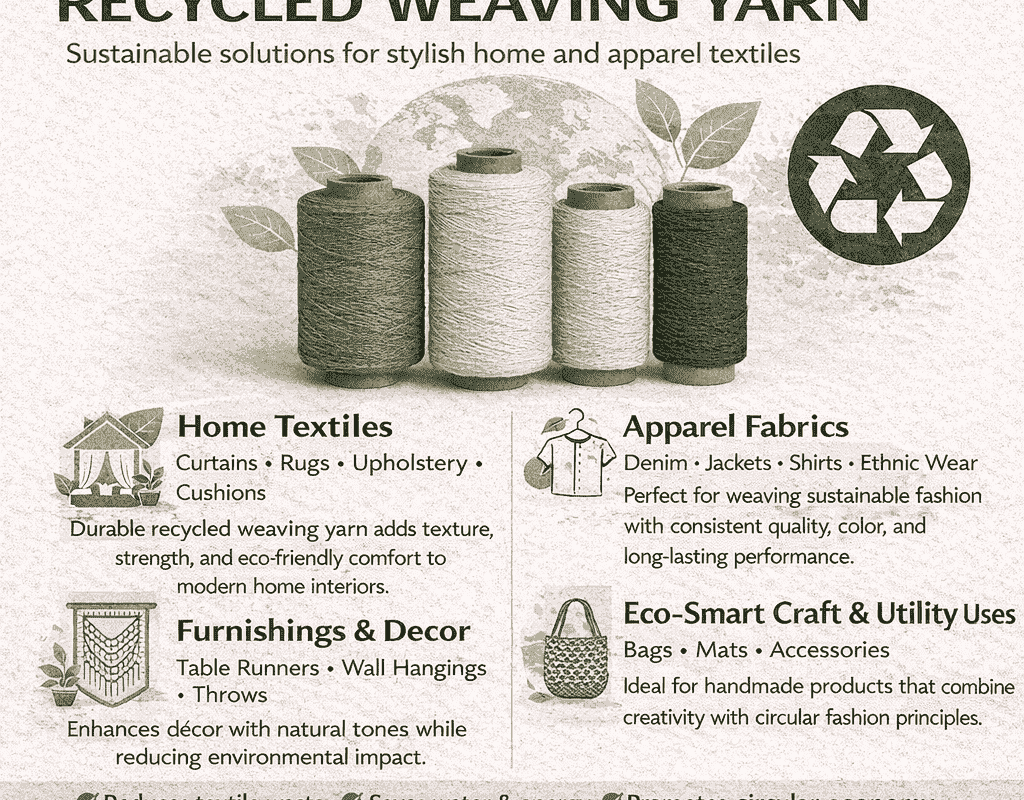
Creative Uses for Recycled Weaving Yarn in Home and Apparel Textiles

Creative Uses for Recycled Weaving Yarn in Home and Apparel Textiles

Creative Uses for Recycled Weaving Yarn in Home and Apparel Textiles

Sustainability is no longer a trend—it has become a defining principle of the modern textile industry. As manufacturers and consumers alike seek eco-friendly alternatives, recycled weaving yarn has emerged as a versatile and innovative solution. By transforming textile waste into high-quality yarn, recycled weaving yarn supports responsible production while offering endless creative possibilities in both home and apparel textiles. At the forefront of this movement is KS Spinning Mills, a trusted name in sustainable yarn manufacturing.

Understanding Recycled Weaving Yarn

Recycled weaving yarn is produced by reprocessing post-industrial or post-consumer textile waste into usable fibers that can be spun into yarn. These yarns are designed to meet the performance requirements of weaving applications while significantly reducing environmental impact.

Modern advancements in recycling and spinning technology have improved yarn strength, consistency, and appearance, making recycled weaving yarn suitable for a wide range of creative textile applications. KS Spinning Mills focuses on delivering recycled yarn that balances sustainability with quality and durability.

The Growing Demand for Sustainable Textiles

Rising awareness of environmental issues has reshaped consumer expectations. Today’s buyers actively look for products made with recycled materials and sustainable practices. Textile brands are responding by incorporating recycled yarns into their collections, not only to reduce their carbon footprint but also to tell a compelling sustainability story.

Recycled weaving yarn allows manufacturers to align with global sustainability goals while maintaining design flexibility. This shift is driving innovation across home furnishings, fashion, and lifestyle products.

Creative Applications in Home Textiles

1. Upholstery Fabrics

Recycled weaving yarn is increasingly used in upholstery fabrics for sofas, chairs, and cushions. Its durability and strength make it ideal for high-use applications, while textured finishes add a modern aesthetic.

KS Spinning Mills supplies recycled weaving yarn that supports long-lasting upholstery solutions, helping furniture manufacturers create stylish and sustainable products.

2. Curtains and Drapery

Lightweight and medium-weight recycled yarns are well-suited for curtains and drapery. They offer excellent drape, breathability, and color retention, making them both functional and visually appealing.

Using recycled weaving yarn in window furnishings helps reduce environmental impact while enhancing interior design with contemporary textures and patterns.

3. Rugs and Floor Coverings

Handwoven and machine-woven rugs made from Recycled Weaving Yarn are gaining popularity for their durability and eco-friendly appeal. These rugs combine strength with unique textures, making them ideal for residential and commercial spaces.

KS Spinning Mills ensures consistent yarn quality to support uniform weaving and long-lasting performance in floor coverings.

4. Bedding and Soft Furnishings

Recycled weaving yarn is also used in bedspreads, throws, cushion covers, and table linens. These products benefit from the yarn’s softness, breathability, and resilience, offering comfort without compromising sustainability.

Innovative Uses in Apparel Textiles

5. Casual Wear and Everyday Apparel

Recycled weaving yarn is widely used in shirts, dresses, trousers, and casual wear fabrics. With improved softness and uniformity, these yarns allow designers to create comfortable garments suitable for everyday use.

KS Spinning Mills works closely with apparel manufacturers to supply yarns that meet fashion industry standards while supporting sustainable production.

6. Denim and Structured Fabrics

Denim is one of the most resource-intensive textiles, making it an ideal candidate for recycled yarn integration. Recycled weaving yarn can be blended into denim fabrics to reduce water and energy consumption while maintaining durability.

This creative use supports eco-conscious fashion without compromising the iconic strength of denim.

7. Workwear and Utility Clothing

Recycled weaving yarn is also suitable for workwear fabrics that require strength and abrasion resistance. From uniforms to utility garments, recycled yarn contributes to long-lasting textiles that meet functional demands.

KS Spinning Mills provides yarn solutions that balance performance and sustainability for industrial and workwear applications.

8. Accessories and Lifestyle Products

Accessories such as bags, scarves, belts, and caps are perfect for showcasing Recycled Weaving Yarn. These products highlight texture, craftsmanship, and sustainability, appealing to environmentally conscious consumers.

Design Freedom and Aesthetic Versatility

One of the biggest advantages of recycled weaving yarn is its design flexibility. It can be produced in various counts, textures, and colors, enabling designers to experiment with patterns, finishes, and fabric weights.

KS Spinning Mills invests in advanced processing techniques to ensure recycled yarn meets aesthetic expectations while maintaining consistent quality.

Sustainability Benefits Beyond Aesthetics

Using recycled weaving yarn offers multiple environmental advantages, including:

  • Reduced textile waste in landfills
  • Lower water and energy consumption
  • Reduced reliance on virgin raw materials
  • Support for circular economy initiatives

These benefits make recycled weaving yarn a responsible choice for brands seeking long-term sustainability.

The Role of KS Spinning Mills in Sustainable Innovation

As a leading yarn manufacturer, KS Spinning Mills plays a key role in promoting recycled weaving yarn across home and apparel textiles. The company combines responsible sourcing, advanced technology, and quality assurance to deliver yarn solutions that meet evolving market demands.

By focusing on innovation and sustainability, KS Spinning Mills helps textile manufacturers transform creative ideas into high-quality, eco-friendly products.

Future Trends in Recycled Weaving Yarn

The future of recycled weaving yarn lies in continuous innovation. As technology improves, recycled yarns will offer even greater consistency, softness, and performance. Designers and manufacturers will continue exploring new applications, blending sustainability with creativity.

With increasing consumer demand and regulatory support, recycled weaving yarn is set to become a standard material in textile production.

Conclusion

Recycled weaving yarn opens up a world of creative possibilities in both home and apparel textiles. From upholstery and rugs to casual wear and accessories, its versatility, durability, and sustainability make it an ideal choice for modern textile manufacturing.

By partnering with trusted manufacturers like KS Spinning Mills, brands can embrace sustainable innovation without compromising on quality or design. As the textile industry evolves, recycled weaving yarn will remain a powerful tool for creating responsible, stylish, and future-ready textiles.
Why Brands Are Switching to Recycled Weaving Yarn: Trends & Insights 2025

Why Brands Are Switching to Recycled Weaving Yarn: Trends & Insights 2025

Why Brands Are Switching to Recycled Weaving Yarn: Trends & Insights 2025

The shift toward Recycled Weaving Yarn is no longer a niche sustainability experiment — in 2025 it’s a strategic business decision for many brands. From headline corporate commitments to quieter supply-chain investments, the textile value chain is reorganizing around circular feedstocks. This post explores the forces driving brands to switch, the technologies and economics enabling adoption, and what to expect next.

Why the switch is accelerating now

Brands face a rare convergence of pressure and opportunity. Regulators and NGO campaigns are tightening the spotlight on plastic and textile waste, and large industry initiatives have set ambitious recycled-content targets that push buyers to change suppliers or materials. Textile Exchange’s 2025 Recycled Polyester Challenge — which asks companies to commit to substantially raise their recycled polyester use by 2025 — has been a major accelerant, prompting many brands to convert lofty sustainability goals into procurement plans.

At the same time, market economics are shifting. Demand for recycled yarns is growing fast enough that production scale is improving and specialized recycled feedstocks are becoming commercially available, shrinking the price gap with some virgin materials. Market analyses show the recycled yarn segment expanding strongly as both manufacturers and brands chase predictable, certified recycled inputs.

Practical drivers for brand adoption

  1. Targeted corporate commitments — Major brands increasingly publish specific recycled-content targets or sign industry compacts. These commitments create purchase volume, which helps recyclers and yarn mills justify investment in new equipment and processes.
  2. Consumer expectations — The sustainable-purchase cohort now demands traceability and real recycled content, not vague “eco” claims. Brands that advertise verified recycled content gain market differentiation and reduce reputational risk.
  3. Supply-chain resilience — Recycled feedstocks can help diversify raw material sources and reduce exposure to petrochemical price shocks or cotton shortages, improving long-term sourcing resilience.

Technology and process advances enabling quality parity

Two technical pathways dominate recycled yarn production today: mechanical recycling and chemical (or feedstock) recycling. Mechanical recycling — shredding and re-spinning textile waste — has matured to deliver usable yarns for many woven applications, particularly when blended with virgin fiber to regain strength and hand. Chemical recycling breaks polymers down to monomers and rebuilds them, producing material much closer to virgin polyester and opening the door for higher-quality, closed-loop textile-to-textile recycling. Ongoing lab and pilot work (including solvent-assisted separations for polyblend textiles) are improving yields and broadening which waste streams can be recycled into premium yarns.

Real-world examples: brand partnerships and offtake deals

We’re seeing concrete commercial arrangements rather than just press releases. Fashion brands are signing multi-year offtake and supply deals with chemical-recycling startups and experienced recyclers, committing to purchase next-generation recycled polymers and yarns for upcoming collections. These partnerships demonstrate the confidence brands have in recycled solutions to meet quality, volume, and timing needs — and they give recyclers the revenue certainty to scale. A notable example in recent industry coverage: brands entering multi-year agreements to secure recycled polyester made from post-consumer textile waste.

Economics: cost, certification, and total value

Cost remains nuanced. For some product categories and regions recycled yarns are already cost-competitive; in others they carry a premium that brands must absorb or pass to consumers. Importantly, brands aren’t only paying for raw material: they’re buying verified sustainability, reduced scope-3 emissions, and brand goodwill. Certification schemes (e.g., GRS/RCS and other chain-of-custody programs) play a major role in turning recycled inputs into credible marketing claims — and in many cases, certified recycled content is what buyers will pay extra for.

Design and manufacturing implications

Switching to recycled weaving yarn requires changes across product development and mill operations. Designers must understand the character of recycled yarns (e.g., subtle heathering, fiber shortness) and specify blends and finishes that preserve desired drape and strength. Mills often pilot small-batch runs to optimize spin-twist, finishing, and weaving settings for recycled counts. Brands that invest up front — in technical support, sampling, and flexible specs — avoid disappointing product launches and accelerate scale.

Risks and how brands mitigate them
• Feedstock variability — Post-consumer textile streams can vary; better collection schemes and stricter input sorting reduce contamination.
• Greenwashing risk — Transparent traceability, third-party certification, and honest marketing are essential to maintain consumer trust.
• Performance gaps — For high-performance or technical textiles, brands may still need virgin or engineered fibers; strategic blending and targeted use cases solve many of these challenges.

What 2025 showed us — and what’s next

2025 has been a year of scaling pilots into production. Investment headlines, new recycling plants, R&D breakthroughs, and a steady stream of brand–recycler partnerships mean Recycled Weaving Yarn is moving from experimental to mainstream for many fabric categories. Market forecasts and industry roundups point to continued growth in recycled yarn demand and ongoing investment across mechanical and chemical recycling routes.

For brands considering the switch: a short action checklist
• Set measurable recycled-content targets and align them with procurement. (Industry compacts can help.)
• Source certified recycled yarns where possible and require chain-of-custody documentation.
• Start with blended constructions and proven applications (e.g., casualwear, home textiles) before moving into technical lines.
• Partner with recyclers and mills on pilots to co-develop specifications and volume forecasts.
• Communicate transparently with consumers — explain tradeoffs and the benefits clearly to avoid confusion or skepticism.

Final thought
Recycled weaving yarn is transforming how fabrics are made by aligning environmental goals with practical manufacturing solutions. In 2025 the transition is being driven by credible targets, technological advances, and market demand. For brands, switching to recycled yarn is no longer just an ethical statement — it’s a way to future-proof product lines, meet regulatory and consumer expectations, and participate in a circular textile economy. The momentum is real, but the journey requires investment, patience, and openness to new design and sourcing approaches. Those who lead now will have both the supply relationships and the authenticity advantage as circular textiles move from trend to standard.

What Is Recycled Weaving Yarn? A Complete Beginner’s Guide for 2025

What Is Recycled Weaving Yarn? A Complete Beginner’s Guide for 2025

As the world shifts towards smarter, greener textile solutions, the popularity of Recycled Weaving Yarn has skyrocketed—especially among mills, fabric manufacturers, fashion brands, and sustainability-driven consumers. If you’re new to the concept and searching for a simple, beginner-friendly explanation, this guide breaks down everything you need to know in 2025.

What Is Recycled Weaving Yarn?

Recycled weaving yarn is yarn produced from post-consumer or post-industrial textile waste, plastic bottles, cutting scraps, PET waste, and leftover fiber materials. Instead of letting these materials end up in landfills or oceans, recycling mills collect, process, and spin them into new, high-quality yarns—perfect for weaving fabrics.

In short:

✔️ It reduces waste
✔️ It saves natural resources
✔️ It lowers energy consumption
✔️ It supports circular textiles

This makes recycled weaving yarn one of the fastest-growing eco-friendly yarn categories in 2025.

How Recycled Weaving Yarn Is Made

The recycling and spinning process is a combination of technology, precision, and quality control. Here’s how it works step-by-step:

1. Waste Collection

Manufacturers collect:

  • Post-consumer garments
  • Cutting waste from factories
  • PET bottles (for polyester yarns)
  • Discarded home textiles
  • Industrial scraps

2. Sorting & Cleaning

Waste is segregated by:

  • Fiber type
  • Color
  • Quality
  • Contamination levels

This step ensures consistent yarn quality.

3. Shredding

Textiles are shredded into fiber form using high-speed mechanical shredders.

4. Fiber Opening

Fibers are opened, blended, and aligned to create a uniform texture.

5. Carding & Combing

These processes remove impurities and prepare the fiber into slivers for spinning.

6. Spinning into Yarn

Modern ring frames or open-end spinning machines convert fiber into smooth, strong yarn suitable for weaving.

7. Quality Testing

Every batch undergoes:

  • Strength tests
  • Evenness checks
  • Color consistency checks
  • Contamination analysis

8. Final Packaging

The yarn is wound into cones, bales, or customized packaging for mills and exporters.

Types of Recycled Weaving Yarn Available in 2025

The textile industry now offers multiple variants to match fabric needs:

1. Recycled Cotton Weaving Yarn

Made from cotton garment waste and industry scraps.
Ideal for: shirting fabrics, denim blends, bedsheets, towels, and upholstery.

2. Recycled Polyester Weaving Yarn (rPET)

Made from PET bottles and polyester waste.
Ideal for: performance fabrics, denim blends, bags, curtains, and technical textiles.

3. Recycled Cotton-Polyester Blended Yarn

A perfect balance of softness + strength.
Ideal for: home textiles, fashion fabrics, and value-added woven fabrics.

4. Recycled Acrylic & Wool Blends

Used in blankets, shawls, winter fabrics, and upholstery.

5. Color-Sorted Recycled Yarn

Produced without additional dyeing—reducing water usage by up to 90%.

Why Recycled Weaving Yarn Is in High Demand in 2025

The global textile industry is prioritizing sustainability more than ever. Here’s why Recycled Weaving Yarn has become essential:

1. It Reduces Textile Waste

Over 92 million tons of textile waste is generated each year globally. Recycling turns waste into usable raw material—reducing landfill pressure.

2. It Lowers Cost for Manufacturers

Recycled yarns often cost 20%–40% less than virgin yarn due to:

  • Reduced raw material costs
  • Less water and energy usage
  • Eliminated dyeing in color-sorted yarns

3. It Saves Water & Energy

Recycling cotton saves up to:

  • 85% water
  • 60% energy
  • 40% CO₂ emissions

This makes it a smart choice for eco-conscious brands.

4. It Supports Sustainable Certifications

Brands aim for:

  • GRS (Global Recycled Standard)
  • RCS
  • OEKO-TEX
  • IDFL certifications

Using recycled weaving yarn helps achieve these sustainability goals.

5. Consumer Demand Is Rising

Gen-Z and international fashion brands prefer products that:

  • Reduce carbon footprint
  • Use circular textile materials
  • Follow ethical production

This trend boosts demand for recycled yarn every year.

Applications of Recycled Weaving Yarn

Recycled weaving yarn is extremely versatile and can be used in almost every textile category:

1. Home Textiles

  • Bedsheets
  • Pillow fabrics
  • Curtains
  • Blankets
  • Table linens
  • Upholstery

2. Fashion & Apparel

  • Shirts
  • Trousers
  • Denim
  • Jackets
  • Ethnic wear
  • Accessories

3. Industrial & Technical Textiles

  • Interlinings
  • Lining fabrics
  • Geo-textiles
  • Filtration fabrics
  • Workwear

4. Eco-Friendly Product Manufacturing

  • Bags
  • Towels
  • Rugs
  • Handlooms
  • Craft fabrics

In 2025, weaving mills globally are shifting their raw material sourcing toward recycled yarn due to cost advantages and sustainability benefits.

Advantages of Using Recycled Weaving Yarn

1. Cost-Effective

Budget-friendly for bulk manufacturers without compromising on fabric quality.

2. Eco-Friendly

Less water, less energy, and fewer chemicals.

3. Durable & Versatile

Modern recycling technology ensures high strength and evenness.

4. Reduced Carbon Footprint

Perfect for sustainable collections and green-certified products.

5. Available in Multiple Counts

From coarse denims to fine shirting, recycled yarns now support a wide variety of weaving counts.

Challenges in Recycled Weaving Yarn (And How Mills Are Solving Them)

1. Fiber Length Variation

Recycling may shorten fibers.
Solution: Advanced carding & combing systems generate uniform fibers.

2. Color Variation

Especially in color-sorted yarn.
Solution: AI-based color sorting & blending.

3. Contamination

Plastic, metal, and micro-waste can enter during shredding.
Solution: Automated contamination detection systems.

4. Limited Availability of Premium Waste

High global demand is increasing raw material scarcity.
Solution: More collection points and post-consumer garment recycling programs.

In 2025, spinning mills using advanced machinery have largely overcome these issues.

How to Choose the Best Recycled Weaving Yarn in 2025

If you’re sourcing recycled weaving yarn, consider:

✔️ Count range (Ne or Denier)
✔️ Fiber composition (cotton, polyester, blends)
✔️ Certifications (GRS, RCS, IDFL)
✔️ Color consistency
✔️ Yarn strength & evenness
✔️ Application suitability (home textiles, apparel, industrial use)
✔️ Manufacturer reputation

Choosing a trusted spinning mill ensures better and consistent output for weaving.

The Future of Recycled Weaving Yarn

2025 marks a major shift in global textile sourcing. Recycled weaving yarn is no longer an optional trend—it is becoming a global manufacturing standard.

Future innovations include:

  • AI-based waste sorting
  • Zero-dye yarn production
  • Fully circular textile-to-textile systems
  • Biodegradable recycled blends
  • Higher-strength recycled fibers for technical textiles

The industry is moving toward 100% recyclable and reusable textiles, and recycled weaving yarn is leading this transformation.

Conclusion

Recycled weaving yarn is a powerful solution for reducing waste, lowering production costs, and supporting sustainable textile manufacturing. As we move into 2025 and beyond, brands, mills, exporters, and buyers are increasingly prioritizing recycled materials due to their environmental and economic benefits.

If you’re beginning your journey into eco-friendly textile manufacturing, recycled weaving yarn is the perfect place to start.

Recycled Yarn Fabrics

How Recycled Yarn Fabrics Manufacturers Are Transforming the Textile Industry

How Recycled Yarn Fabrics Manufacturers Are Transforming the Textile Industry

A 2025 Sustainability & Innovation Insight

By KS Spinning Mills

The global textile industry is undergoing a major shift—one defined by sustainability, circular production, and environmentally conscious innovation. At the center of this transformation stands the surge in Recycled Yarn Fabrics. Today’s leading recycled yarn fabrics manufacturers are not merely producing yarn; they are redefining how the world thinks about waste, resources, and textile production.

Among these changemakers, KS Spinning Mills has emerged as a front-running force, pushing the boundaries of innovation and proving that sustainability and performance can coexist without compromise.

Why the Textile World Is Turning to Recycled Yarn

The textile industry has long faced criticism for pollution, water consumption, and excessive waste. But the tide has shifted. In 2025, brands, governments, and consumers are collectively demanding sustainable alternatives—and recycled yarn fabrics have become a powerful solution.

Here’s why recycled yarn is reshaping the industry:

1. A Massive Reduction in Waste

Every year, millions of tons of cotton, polyester, and garment waste end up in landfills. Recycled yarn manufacturers convert this waste into usable, high-quality yarn—cutting down landfill load and extending the lifecycle of textile materials.

2. Much Lower Environmental Impact

Producing new (virgin) fiber requires huge amounts of water, energy, and chemicals. In contrast, recycled yarn production uses significantly less resources—making it one of the most environmentally efficient methods of textile manufacturing.

3. Rising Consumer Demand for Sustainable Clothing

Consumers, especially the younger generation, want transparency. They want brands that care about the planet—and recycled yarn fabrics are a simple, effective way for brands to meet that expectation.

4. Global Regulations Pushing Companies to Go Green

International markets now require brands to comply with environmental standards. Using recycled materials helps companies meet global compliance norms with ease.

The New Era of Recycled Yarn: Innovation Meets Responsibility

Recycling yarn is no longer just about shredding old fabric and spinning new yarn. Modern Recycled Yarn Fabrics Manufacturers use advanced technologies to produce yarns with strength, softness, and durability comparable to virgin fiber.

Let’s explore the innovations transforming the industry.

1. Technology-Driven Segregation & Sorting

Today’s manufacturers use:

  • Automated fiber separation machines
  • Color-coded waste sorting systems
  • AI-powered quality inspection tools

This ensures that recycled fibers match quality standards required for exports and premium fabrics.

KS Spinning Mills uses advanced sorting technologies to maintain color consistency and fiber purity, resulting in uniform, reliable recycled yarn ideal for weaving and knitting applications.

2. Blending for Strength, Comfort & Versatility

One of the biggest advancements is fiber blending.
Manufacturers blend:

  • Recycled cotton
  • Recycled polyester
  • Recycled acrylic
  • Viscose
  • Elastane
  • Organic cotton

This produces yarns that offer a perfect balance of strength, elasticity, and comfort.

KS Spinning Mills is known for its custom blends that are ideal for:

  • T-shirts
  • Sweaters
  • Towels
  • Rugs
  • Blankets
  • Upholstery fabrics
  • Home textiles

This flexibility makes recycled yarn suitable for diverse industries across the world.

3. Pre-Dyed Recycled Yarn: Zero Chemical Waste

Another innovation that is revolutionizing textile production is pre-dyed recycled yarn.

Since waste fabrics are already colored, manufacturers reuse these fibers without needing additional dyeing.
This saves:

  • 1000s of liters of water
  • Chemical usage
  • Time and energy

KS Spinning Mills specializes in producing pre-dyed recycled yarn, making it one of the most eco-friendly options for fabric manufacturers.

4. Improved Spinning Technologies for Performance

Modern OE (Open-End) and Ring Spinning machines have allowed recycled yarn manufacturers to produce yarn that is smoother, stronger, and more consistent.

KS Spinning Mills uses:

  • High-speed spinning frames
  • Advanced rotor systems
  • Precision contamination removal systems

These technologies improve yarn uniformity and reduce breakage—ensuring that the yarn performs well during weaving, knitting, and garment production.

5. Certifications That Guarantee Authentic Sustainability

In 2025, global buyers demand certified sustainable products. Top-tier recycled yarn fabrics manufacturers follow international standards like:

  • GRS – Global Recycled Standard
  • OEKO-TEX
  • ISO Quality Systems
  • Traceability Compliance Standards

KS Spinning Mills adheres to globally recognized certification systems—giving customers complete confidence in sustainability, quality, and traceability.

How Recycled Yarn Manufacturers Are Changing the Market Landscape

With sustainability at the forefront, recycled yarn has disrupted the textile industry in ways that were unimaginable a decade ago. Here’s how:

1. Circular Fashion Is Becoming the New Standard

The traditional textile model was linear:
Produce → Use → Throw Away

But today, the model is circular:
Produce → Use → Recycle → Reuse

Recycled yarn manufacturers are the backbone of this circular economy. They ensure that textile waste re-enters the supply chain instead of harming the planet.

2. Cost-Effective Manufacturing Without Compromising Quality

Recycling helps reduce raw material costs. This cost advantage benefits:

  • Small garment units
  • Export houses
  • Home furnishing manufacturers
  • Larger multinational brands

KS Spinning Mills helps its partners reduce manufacturing costs while offering high-quality, reliable recycled yarn at scalable volumes.

3. Global Brands Are Partnering with Indian Manufacturers

India has become a global hub for recycled yarn due to:

  • Advanced technology
  • Skilled labor
  • Large-scale textile waste availability
  • Strong export infrastructure

KS Spinning Mills is one of the manufacturers consistently supplying to global buyers who want sustainable yet premium yarn options.

4. The Home Textiles Sector Is Booming

Recycled yarn is perfect for:

  • Carpets
  • Rugs
  • Throws
  • Blankets
  • Cushion fabrics
  • Upholstery

Manufacturers like KS Spinning Mills play a major role in supporting India’s home textile export growth by supplying durable, high-strength yarns.

5. Eco-Friendly Practices Are Becoming Brand Identity

Brands are increasingly using recycled yarn as a way to market sustainability.
Labels like:

  • “Made from Recycled Yarn”
  • “Sustainable Fabrics”
  • “GRS-Certified Recycling”

…help brands win trust and sell products faster.

KS Spinning Mills provides complete documentation and traceability support to help brands market their eco-friendly initiatives with authenticity.

Why KS Spinning Mills Leads the Transformation

With its unwavering commitment to sustainability, quality, and innovation, KS Spinning Mills stands out as one of India’s most trusted recycled yarn fabrics manufacturers.

What sets KS Spinning Mills apart?

✔️ Advanced recycling & spinning technology
✔️ High-quality color-sorted recycled yarn
✔️ Ability to produce bulk export quantities
✔️ Customized blends for every industry
✔️ Certified sustainable production processes
✔️ Strong global supply chain capabilities

From home textiles to fashion garments, KS Spinning Mills delivers products that meet the demands of today’s eco-conscious market.

Final Thoughts

The textile industry is changing—and changing fast. Recycled yarn is no longer an option; it is a necessity for brands that want to thrive in a sustainable world. Thanks to innovative recycled yarn fabrics manufacturers like KS Spinning Mills, the industry is moving toward a cleaner, smarter, and more responsible future.

By choosing recycled yarn fabrics, brands not only reduce environmental impact but also move towards a truly circular economy—one where every thread tells a story of renewal and responsibility.

1 2 3 8